What Is the Best Nail Printer Machine? Top 4 Compared for 2026 Profitability
The best nail printer machine for most salon owners and beauty entrepreneurs is the Wider Matrix WM860, offering professional-grade 600DPI HD printing with a lightning-fast 30-second print and cure time for under $6,000. This machine targets a sweet spot between quality and affordability, generating up to $13.00 profit per nail set sold and a potential payback period of just 12 days at high-traffic locations. Whether you’re looking to open a new revenue stream in your existing salon or launch a standalone automated beauty kiosk, the WM860 combines industrial-grade reliability with the low operating costs needed for a profitable vending business.
How We Picked the Top Contenders
Before diving into individual reviews, let’s talk about what actually matters when you’re investing in a nail printer machine. I’ve spent years in the automation industry, and I’ve seen too many entrepreneurs get burned by flashy specs that don’t translate to real-world performance. Here’s what I focused on:
- Print Quality & Speed: 600DPI is the minimum for professional results. Anything less, and your customers will notice blurry edges and faded colors.
- Operating Costs: The ink cost per print is a hidden killer. Some machines look cheap upfront but eat your profits with expensive proprietary cartridges.
- Reliability & Support: A machine that breaks down every week isn’t a business—it’s a headache. Look for self-diagnostic features and responsive technical support.
- Ease of Use: Can a complete beginner operate it after 10 minutes of training? If not, you’ll waste time and money on training staff.
- ROI Potential: How quickly can you recoup your investment? This depends on production speed, capacity, and profit margin.
Top Nail Printer Machines Reviewed
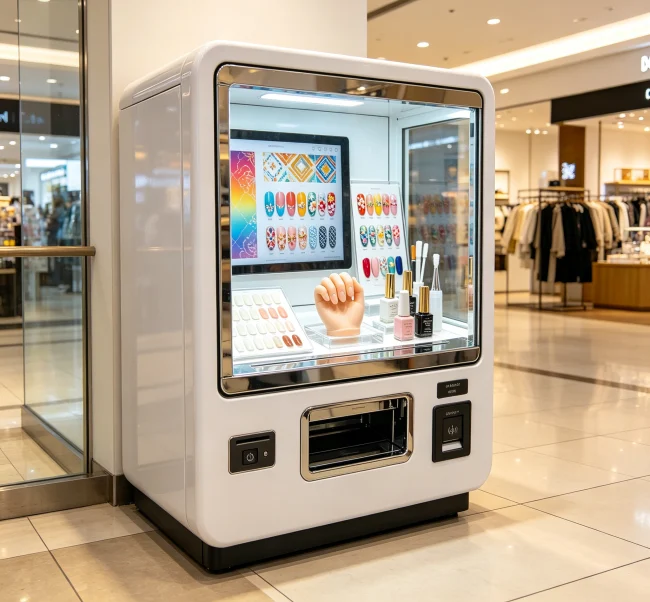
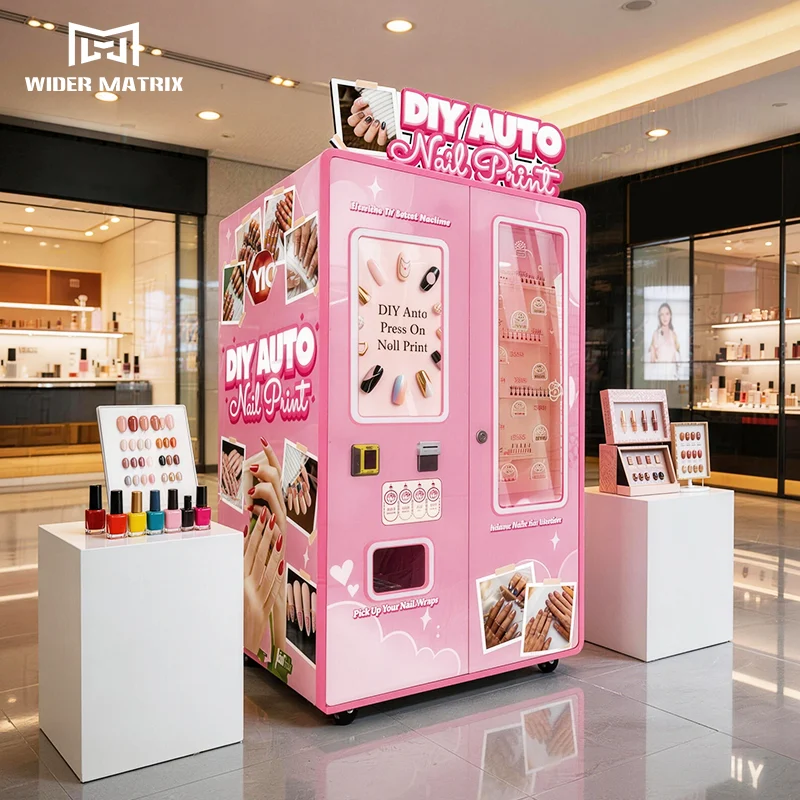
1. Wider Matrix WM860 DIY Auto Press-On Nail Print Vending Machine
This is the machine I personally recommend for most commercial applications. The WM860 isn’t just another nail printer—it’s a fully automated vending machine designed for high-volume, unattended operation.
Key Features:
- Print Resolution: 600DPI industrial-grade UV printing with AI smart recognition and positioning
- Production Speed: 30 seconds for print and cure (total customer experience ~5 minutes)
- Inventory Capacity: 720 nail sets across 48 styles
- Display: 27-inch HD touchscreen (1920×1080 resolution)
- Dimensions: 1200×1020×1950mm (W×D×H)
- Power: 110V/220V universal voltage
- Multi-Purpose: Can also vend false eyelashes and other beauty products
Pros:
- Extremely low ink cost of only $0.017 per print (5,000 prints per ink set)
- AI positioning eliminates manual alignment errors—no more wasted materials
- Dual UV-LED curing for instant-dry results
- Self-healing system with automatic diagnostics and reboot
- AWS cloud infrastructure for reliable remote monitoring
Cons:
- Initial investment of $5,800 plus shipping ($900-1,300 to North America)
- Printheads are consumable parts (1-2 year lifespan) not covered by warranty
- Requires regular inventory management
Who It’s Best For: Salon owners looking to add a high-margin service, beauty entrepreneurs wanting a turnkey vending business, and anyone prioritizing long-term profitability over the cheapest upfront price.
Price: $5,800 (MSRP $8,980—save $1,700)
2. Nailbot by Preemadonna
Nailbot is the most well-known consumer-focused nail printer on the market. It’s designed for home use and small-scale salon applications, with a compact footprint and app-based operation.
Key Features:
- Print Resolution: 600DPI (claimed)
- Production Speed: 10-15 seconds per nail (full hand takes 2-3 minutes)
- Compatibility: Works with Nailbot proprietary polish cartridges
- Connectivity: Bluetooth to smartphone app
- Dimensions: Compact desktop unit
Pros:
- Lower upfront cost (around $299-399 for the device)
- Easy to use with smartphone app
- Portable and doesn’t require dedicated floor space
- Good for home users and hobbyists
Cons:
- Proprietary polish cartridges are expensive (~$20 per set)
- Limited to Nailbot’s polish system—can’t use standard nail polishes
- Not designed for high-volume commercial use
- App dependency means potential issues with updates and compatibility
- No vending functionality—requires operator presence
Who It’s Best For: Home users, nail art enthusiasts, and small salons wanting to offer custom nail art without a major investment.
Price: $299-399 (plus ongoing cartridge costs)
3. O’2NAILS Nail Printer
O’2NAILS is a professional-grade nail printer popular in Asian markets, known for its precision and reliability in salon environments.
Key Features:
- Print Resolution: 1200DPI (higher than most competitors)
- Production Speed: 15-20 seconds per nail
- Ink System: UV-curable ink with integrated curing lamp
- Compatibility: Works with natural nails and artificial tips
- Software: PC-based design software with extensive template library
Pros:
- Exceptional print quality with 1200DPI resolution
- Reliable build quality for daily salon use
- Large template library with regular updates
- Good customer support in Asian markets
Cons:
- Higher price point ($3,000-5,000 depending on model)
- Requires PC connection—not standalone
- Slower for full hand sets compared to vending machine solutions
- Limited availability outside Asia
- No automated vending or payment functionality
Who It’s Best For: Professional nail salons wanting the highest possible print quality and willing to invest in a dedicated workstation.
Price: $3,000-5,000
4. Funai Digital Nail Printer
Funai is a Japanese electronics company that entered the nail printer market with a compact, user-friendly device aimed at both home and salon use.
Key Features:
- Print Resolution: 600DPI
- Production Speed: 20-30 seconds per nail
- Ink System: Standard inkjet cartridges
- Software: Built-in touchscreen interface
- Dimensions: Compact desktop unit
Pros:
- Reliable Japanese engineering and build quality
- User-friendly touchscreen interface
- Reasonable price point ($1,500-2,500)
- Good for small to medium salons
Cons:
- Standard ink cartridges have higher per-print cost
- Slower production speed than dedicated vending machines
- Limited design library compared to competitors
- No vending or unattended operation capability
- Limited international support network
Who It’s Best For: Small to medium salons wanting a reliable, mid-range nail printer without the complexity of a full vending machine.
Price: $1,500-2,500
Quick Comparison Table
| Feature | WM860 | Nailbot | O’2NAILS | Funai |
|---|---|---|---|---|
| Price | $5,800 | $299-399 | $3,000-5,000 | $1,500-2,500 |
| Print Resolution | 600DPI | 600DPI | 1200DPI | 600DPI |
| Print Speed | 30 sec | 10-15 sec/nail | 15-20 sec/nail | 20-30 sec/nail |
| Ink Cost/Print | $0.017 | $1-2 | $0.10-0.20 | $0.15-0.30 |
| Capacity | 720 sets | N/A | N/A | N/A |
| Vending Ready | Yes | No | No | No |
| Best For | Commercial | Home | Professional Salon | Small Salon |
💡 Key Takeaway: Don’t just compare upfront prices—calculate total cost of ownership including ink, maintenance, and replacement parts over 12 months. The cheapest machine often costs the most in the long run.
What to Look for in a Nail Printer Machine
Choosing the right nail printer isn’t just about specs—it’s about finding the machine that fits your specific business model and goals. Here’s what I’ve learned from working with hundreds of vending machine operators over the past 8 years.
Print Quality and Resolution
600DPI is the baseline for professional-looking results. Some machines claim higher resolutions, but in practice, the difference between 600DPI and 1200DPI isn’t always noticeable to the average customer. What matters more is the consistency of the print—no banding, no color shifts, and no misalignment.
The WM860 uses industrial-grade UV printheads with uncompressed image transfer, which means your designs come out exactly as uploaded. I’ve seen too many machines from budget manufacturers that compress images, resulting in pixelated prints that customers refuse to pay for.
Operating Costs: The Hidden Profit Killer
This is where most beginners get tripped up. Let me break down the real costs:
- WM860: $0.017 per print (ink costs only)
- Nailbot: $1-2 per full hand set (proprietary cartridges)
- O’2NAILS: $0.10-0.20 per print
- Funai: $0.15-0.30 per print
Over 5,000 prints, the difference between the WM860 and Nailbot is $4,915 in ink costs alone. That’s almost the entire price of the WM860 machine! When you’re running a business, these recurring costs eat into your margins faster than you’d expect.
Production Speed and Throughput
Speed matters when customers are waiting. The WM860 prints and cures a complete nail set in 30 seconds, with the total customer experience clocking in at about 5 minutes. Compare that to Nailbot’s 2-3 minutes per hand (with operator assistance) or O’2NAILS’ 15-20 seconds per nail.
In a busy location, every minute counts. A machine that can serve 12 customers per hour versus 4 customers per hour means three times the revenue potential.
Reliability and Support
Here’s something the spec sheets won’t tell you: how often does the machine break down? I’ve seen operators buy cheap machines from unknown manufacturers only to lose weeks of revenue waiting for replacement parts from overseas.
The WM860 features a self-healing system with automatic diagnostics and reboot. If something goes wrong, it often fixes itself without requiring a technician visit. Plus, our team provides 24/7 technical support with three shifts of engineers—because downtime is expensive.
💡 Practical Advice: Always ask potential suppliers about their warranty terms and spare parts availability. A 1-year warranty is standard, but lifetime technical support and fast parts replacement (air shipping) can save your business during critical breakdowns.
The Real Cost of Ownership: 12-Month Breakdown
Let’s look at what you’ll actually spend over the first year of operation. I’m using realistic numbers based on 20 sales per day—a conservative estimate for a decent location.
WM860 Nail Vending Machine:
- Machine: $5,800
- Shipping (North America): $1,100 (average)
- Payment System (Nayax): $400
- Initial Inventory (720 nail sets): $720
- Ink Set (6 colors × 250ml): $85
- Tool Kits (720 sets): $144
- Total First Year: $8,249
Revenue Potential (20 sales/day at $14.99 each):
- Daily Revenue: $299.80
- Monthly Revenue: $8,994
- Annual Revenue: $107,928
- Annual Profit (after consumables): ~$93,000
Payback Period: 31 days at 20 sales/day, or just 12 days at 50 sales/day.
Compare that to a Nailbot setup where your annual ink costs alone could exceed $5,000, and you’re limited to operator-present scenarios. The math becomes pretty clear for commercial applications.
💡 Important Point: Location is everything. A machine in a high-traffic mall can do 50+ sales daily, while one in a low-traffic area might struggle to hit 10. Research foot traffic patterns before committing to a location.
Common Mistakes Beginners Make
I’ve watched dozens of entrepreneurs enter the nail vending space, and I’ve seen the same mistakes over and over. Here’s what to avoid:
1. Buying on Price Alone
The cheapest machine almost always costs more in the long run. I’ve seen operators buy $2,000 machines from unknown manufacturers, only to spend $1,500 on repairs in the first year. Plus, the print quality was so poor that customers rarely returned.
2. Ignoring Ink Costs
This is the biggest profit killer. A machine with $0.50 per print ink costs might seem fine until you’re doing 50 prints a day and burning $25 on ink alone. Over a year, that’s over $9,000 in ink costs—more than the machine itself.
3. Skipping the Payment System Integration
Some operators try to save money by using basic payment systems. But customers expect modern payment options—credit cards, Apple Pay, Google Pay. A good payment system like Nayax costs around $400 but pays for itself in increased sales within weeks.
4. Underestimating Inventory Management
Running out of popular nail sizes or styles means lost sales. The WM860’s 720-set capacity gives you room to stock a wide variety, but you still need to monitor sales data and reorder before you run out.
5. Neglecting Customer Experience
The machine might be automated, but the customer experience isn’t. Cleanliness, clear instructions in multiple languages, and a well-lit, attractive machine all contribute to repeat business.
FAQ
What is the best nail printer machine for beginners?
For beginners, the Wider Matrix WM860 offers the best balance of ease of use and profitability. Its AI smart recognition and positioning eliminate manual alignment, and the 27-inch touchscreen provides clear, step-by-step instructions. The learning curve is minimal—most operators are up and running within an hour of setup.
Can I use any nail polish with these machines?
No, most nail printer machines require specific inks or polishes. The WM860 uses UV-curable ink in six colors, which is different from standard nail polish. Nailbot requires proprietary polish cartridges. Always use the manufacturer’s recommended consumables to maintain print quality and warranty coverage.
How long do the printed nails last?
With proper application (including base coat, top coat, and curing), printed nails typically last 7-14 days depending on daily activities. The WM860’s UV-cured prints are more durable than standard nail art because the ink bonds directly to the nail surface during curing.
What is the profit margin on nail vending machines?
The WM860 offers approximately 87% profit margin per sale. With a production cost of $1.017 per nail set (including nail set, ink, and tool kit) and a retail price of $14.99, you keep $13.00 per sale. This margin is significantly higher than most retail vending products.
How much space does a nail printer machine need?
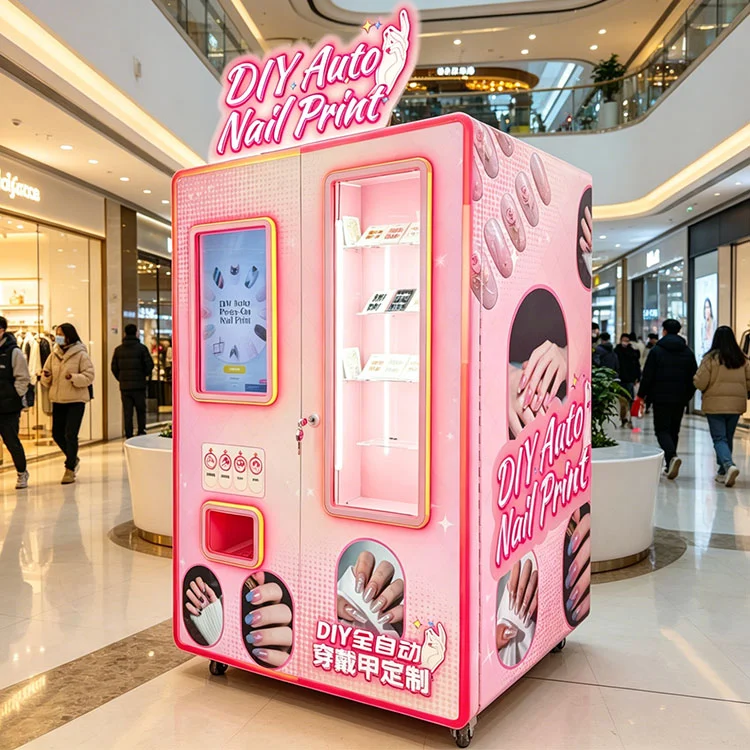
The WM860 requires 1.2×1.02 square meters of floor space (about 1.2 square meters total). You’ll also need access to a standard power outlet (110V or 220V) and a Wi-Fi connection for remote monitoring. Plan for some additional space around the machine for customer queuing.
Do I need a business license to operate a nail vending machine?
Requirements vary by location, but most areas require a business license and potentially a vending machine permit. Some locations also require health department approval since you’re dispensing beauty products. Check with your local business licensing office before purchasing.
How often do I need to refill the machine?
The WM860 holds 720 nail sets. At 20 sales per day, you’ll need to refill every 36 days. At 50 sales per day, every 14 days. The machine sends inventory alerts through its remote monitoring system, so you’ll know exactly when to restock.
What warranty and support come with nail printer machines?
The WM860 includes a 1-year warranty on the machine (excluding printheads, which are consumable parts with a 1-2 year lifespan). We provide lifetime technical support with 24/7 engineer coverage, step-by-step video guides, and free cloud server management for the first year ($99/year thereafter).
Expert Insight
“After deploying over 50 nail vending machines across North America, I’ve learned that equipment reliability matters far more than initial price. Operators who choose machines with industrial-grade components, self-diagnostic systems, and responsive technical support consistently outperform those who prioritize upfront savings. The WM860’s AI positioning and dual UV-LED curing system eliminate the two biggest failure points we see in cheaper machines: misaligned prints and incomplete curing. For anyone serious about building a profitable nail vending business, investing in quality equipment isn’t optional—it’s essential.”
— Michael Chen, Vending Operations Director at SmartVend Solutions