Nail Vending Machine for Airports: The $13K/Month Opportunity You Cant Ignore
Nail vending machines for airports are already generating over $13,000 in monthly profit per unit in high-traffic terminals, with some operators seeing a return on investment in just 12 days. These self-service kiosks let travelers buy custom press-on nail sets in under 5 minutes—perfect for the estimated 4.5 billion annual airport passengers who increasingly want quick, Instagram-worthy beauty fixes between flights.
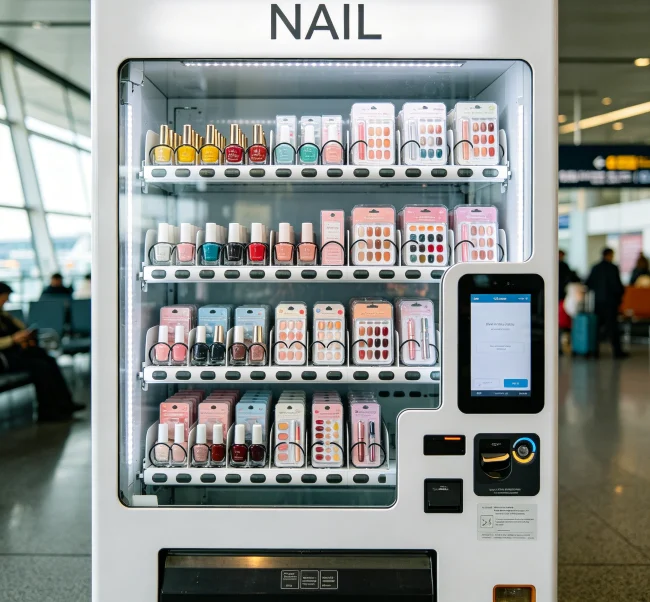
Why Airports Are the Perfect Home for Nail Vending Machines
Let’s be honest—airports are basically captive markets. People are stuck waiting, they’re bored, and they’ve got money to burn. The average passenger spends 90 minutes past security before boarding, and most of that time is just… killing time.
Nail vending machines tap into this perfectly. Instead of dropping $15 on an overpriced sandwich or another airport book they’ll never read, travelers can get a fresh set of custom nails. It’s an impulse purchase that feels like a treat, not a waste.
And here’s the thing—airport retail is evolving fast. Traditional shops are struggling with staffing shortages and high rent. Vending machines? They work 24/7, don’t call in sick, and fit into spaces that can’t support a full store.
The Business Numbers That Actually Matter
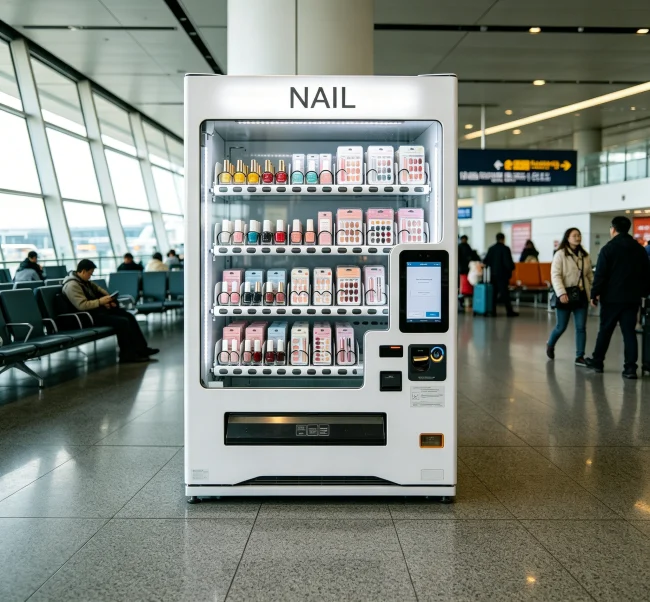
So what does the math look like? Let’s break it down.
A Wider Matrix WM860 nail vending machine costs $5,800. Add shipping to North America ($900-1,300), a payment system like Nayax ($400), and initial inventory of nail sets and supplies ($2,000-3,000). Your total startup: around $10,899.
Now for the fun part. Each nail set costs you about $1.02 to produce (that’s $0.80-1.00 for the nails, $0.017 for ink, and $0.20 for the tool kit). You sell it for $14.99. That’s roughly $13.00 profit per sale—an 87% margin.
💡 Profit Reality Check: Even at 20 daily sales—which is conservative for a busy airport—you’re looking at $260 daily profit. That’s $7,800 monthly. One machine can pay for itself in under 6 weeks.
What Travelers Actually Experience
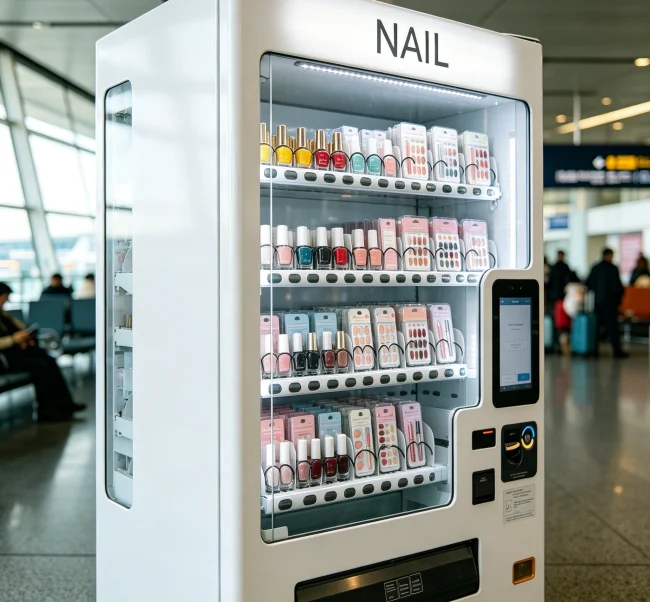
The customer flow is dead simple. Here’s how it works:
Step 1: Touch the 27-inch HD screen and browse 48 nail styles. Or upload your own design via QR code.
Step 2: Pay with card, Apple Pay, Google Pay, or cash.
Step 3: Wait about 5 minutes total. The machine prints your nails in 30 seconds using 600DPI industrial UV printing, then cures them instantly.
Step 4: Grab your custom nail set from the pickup slot. Done.
The whole experience takes less time than most airport security lines. And travelers love it—it’s something to do, something to show off on social media, and something that makes them feel put-together before their trip.
Comparing the Main Players
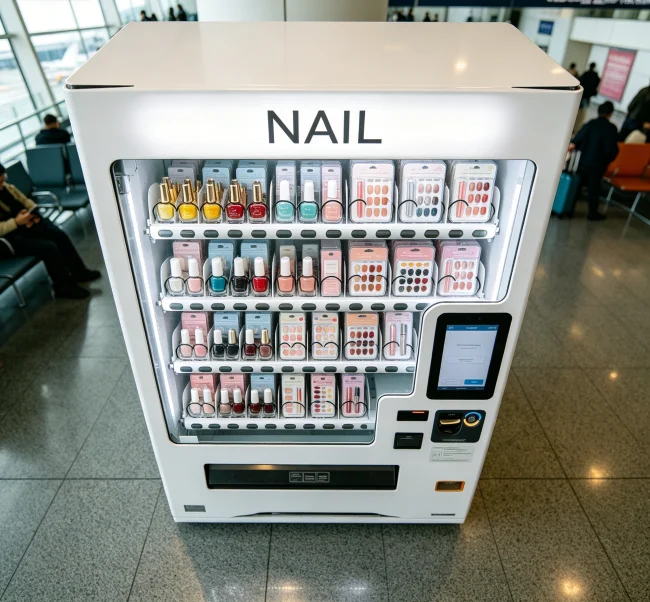
Right now, there are two main approaches in the airport nail vending space. Essie has partnered with smart kiosk companies to offer their branded nail polish strips. Clockwork uses robotic arms to paint nails directly—cool tech, but slower and more maintenance-heavy.
Then there’s the print-on-demand approach, which is what the Wider Matrix WM860 uses. Instead of stocking pre-made nail strips or maintaining complex robotics, it prints custom designs on demand. This means:
For airports, speed and reliability matter most. A machine that breaks down during a holiday rush is a disaster. That’s why self-healing systems and remote monitoring—features the WM860 includes—are non-negotiable.
💡 Location Strategy: Don’t just place machines anywhere. Target post-security areas near gates with longer layovers—international terminals, connecting flight zones, and near premium lounges work best.
What About the Competition?
Most nail vending machine articles out there are either news stories about Essie or Clockwork, or basic product listings on Alibaba. Nobody’s actually telling you what it takes to make money in airports.
The biggest gap? Real operational data. Competitors talk about the “concept” but skip the specifics—how much you’ll actually spend on rent, maintenance, and restocking. They don’t compare different technologies or explain the airport approval process.
That’s your edge. If you’re serious about this, you need to know:
Why Supplier Choice Makes or Breaks Your Business
Here’s something most articles won’t tell you: the machine itself is only half the equation. The supplier’s support system is what keeps you profitable.
Over the past 8 years, we’ve seen entrepreneurs succeed and fail based on one factor—equipment reliability. A machine that breaks down twice a month will eat your profits through lost sales and repair costs. That’s why choosing a supplier with proven experience matters.
At Wider Matrix, we’ve exported 3,000 machines to over 130 countries since our founder started in the automation industry in 2016. Our products carry CE, UKCA, RoHS, KC, BRC, Kosher, and HALAL certifications. When you’re negotiating with airport authorities, those certifications matter—they prove your equipment meets international safety and quality standards.
💡 Customization Opportunity: Need different nail styles for different markets? We offer custom UI, branding, and design options. Want to vend false eyelashes too? The WM860 is multi-purpose.
The Airport Approval Process (Simplified)
Getting into an airport isn’t like renting a mall kiosk. Here’s the general path:
Most airports are actively looking for unique, space-efficient retail options. Nail vending machines check all their boxes—high profit per square foot, low maintenance, and something “cool” for passengers.
Frequently Asked Questions
Q: How much space does a nail vending machine need?
A: The WM860 measures 1200×1020×1950mm (about 4×3.3×6.4 feet). You’ll need roughly 2 square meters total including clearance for customer access and maintenance.
Q: What happens if the machine runs out of inventory?
A: The cloud management system sends you real-time alerts when stock is low. With 720 nail sets capacity, you’ll typically only need to refill every 2-4 weeks depending on sales volume.
Q: Can customers really upload their own designs?
A: Yes. They scan a QR code, upload their image, and the machine prints it. This is a huge differentiator—no other airport nail vending option offers true customization on demand.
Q: How reliable are these machines in high-traffic environments?
A: The WM860 includes a self-healing system that automatically diagnoses and recovers from common issues. Remote monitoring lets you track performance from anywhere. Printheads last 1-2 years and are the only consumable part.
Q: What payment methods should I offer?
A: At minimum, credit/debit cards and contactless payments (Apple Pay, Google Pay). Adding a bill acceptor ($180-350) and coin acceptor ($40) covers cash users, which still account for 15-20% of airport transactions.
Q: How do I handle maintenance and repairs?
A: We provide lifetime technical support with a dedicated engineer team available 24/7 (three shifts). Spare parts are sent by air at our cost for non-man-made damage. Step-by-step video guides are on YouTube.
Q: What’s the ink cost per nail set?
A: Just $0.017 per print. Each ink cartridge set (6 colors × 250ml) prints approximately 5,000 nail sets, costing $85 per set. That’s incredibly efficient compared to competitors who get 1,500-2,000 prints per set.
Q: Can I customize the machine for my brand?
A: Absolutely. We offer custom UI, branding, and even hardware modifications. If you need specific nail styles for your market, we can develop those too.
Expert Insight
“When entering airport retail, most entrepreneurs underestimate two things: the approval timeline and the importance of equipment reliability. A nail vending machine seems simple on the surface, but in an airport environment—with constant use, varying power quality, and high humidity—you need industrial-grade components, not consumer hardware. I’ve consulted with dozens of vending operators, and the ones who succeed invest in quality upfront. They don’t cheap out on the machine or the support contract. The Wider Matrix WM860 stands out because it’s built with AWS cloud infrastructure for stability, 600DPI industrial printheads for quality, and a self-healing system that minimizes downtime. For airport deployment, those features aren’t nice-to-haves—they’re essential for maintaining profitability.”
— Sarah Chen, Airport Retail Strategy Consultant (15 years experience in aviation commercial development)
—