High-Profit Phone Case Vending Machine from a Chinese Factory: What Actually Works in 2026
Two weeks. That’s how long it took a first-time operator in Texas to get his money back on a single WM880 unit placed at a suburban mall food court. Not because phone cases are magic, but because the unit economics of a custom-printed case are almost uncomfortably good when you buy the hardware and consumables direct from the factory that builds them.
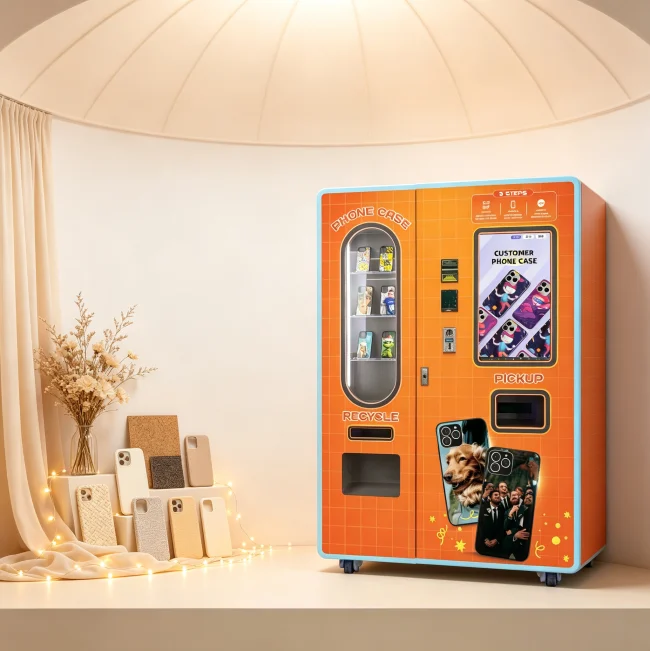
That’s the part most people miss when they search for a high-profit phone case vending machine from a Chinese factory. The machine matters, sure. But the margin comes from the whole stack — print head, case cost, ink yield, and how fast the thing turns around a customer. Get those four things right and you’re looking at gross margins north of 90%. Get them wrong and you’re stuck with a $6,000 aluminum box that eats ink and jams on busy Saturdays.
We build these machines. So this isn’t a sales pitch disguised as a guide — it’s what we’d tell a friend who asked us over coffee whether this business is worth getting into.
Why the Factory Direct Route Changes the Math
Here’s something that surprises almost every new buyer: the print head alone can be 30-40% of a machine’s component cost. Epson industrial nozzles aren’t cheap, and there’s a global supply chain behind them that most resellers don’t have direct access to. When you buy through a middleman, you’re paying for their markup on top of a component they also bought at a markup.
Buying from the factory cuts that chain. But it also means you inherit responsibility for understanding what you’re buying — which is exactly why so many people get burned by cheap units from trading companies that slap together components and disappear when something breaks.
The way to tell the difference? Ask for the production facility. Ask how many machines they’ve actually deployed. Ask what happens when a print head fails in month seven.
We’ve had operators come to us after buying from a reseller, only to find out the “factory” was a warehouse with three staff and no engineering team. The machine worked for four months. Then the mainboard died and nobody could source a replacement.
The Three Models Worth Comparing (and What Separates Them)
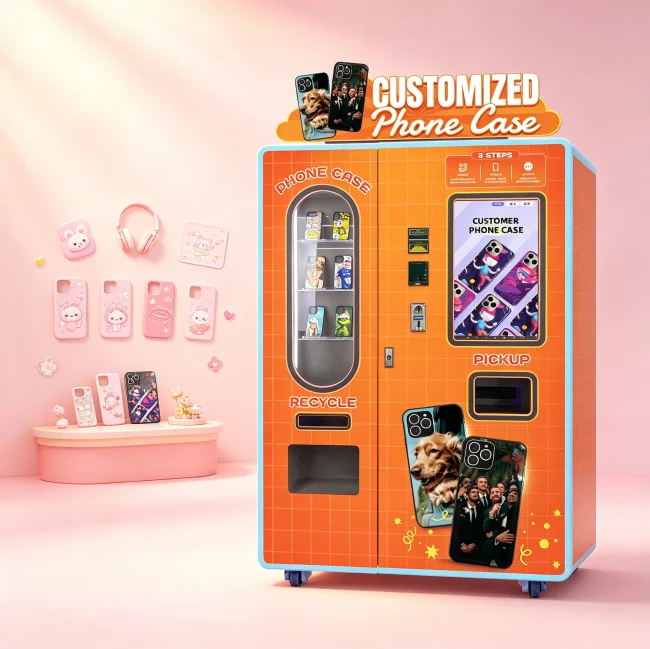
Every phone case machine we ship falls into one of three configurations. The differences are real, and they matter more than the spec sheet suggests.
| Model | Print Head | Capacity | Reference Price | Best For |
|---|---|---|---|---|
| WM880 F1080 | Epson F1080 | 1,020 cases | US$5,299 | First-time operators, moderate traffic |
| WM880 i1600u1 | Industrial UV i1600 | 1,025 cases | US$6,299 | High-traffic venues, daily 40+ sales |
| WM880+ | Industrial i3200 | 1,025 cases | US$6,979 | Premium print quality, brand partnerships |
The jump from F1080 to i1600 isn’t cosmetic. You get triple the print speed, quadruple the nozzle lifespan, and roughly double the clarity. For a mall kiosk doing 50 cases a day, that speed difference is the gap between a smooth queue and a crowd of annoyed teenagers walking away.
The i3200 upgrade is a different conversation. It’s for operators who’ve already validated their location and want the absolute best print resolution on the market. The +$680 upgrade cost is worth it if you’re selling into a demographic that cares about image quality — think convention centers, tourist districts, anywhere people photograph their purchases.
One honest note: if you’re testing your first location, the F1080 version is genuinely fine. Don’t let anyone talk you into the premium tier before you’ve proven the concept. Start lean, upgrade later if the data tells you to.
The Real Profit Numbers (Not the Ones on Brochures)
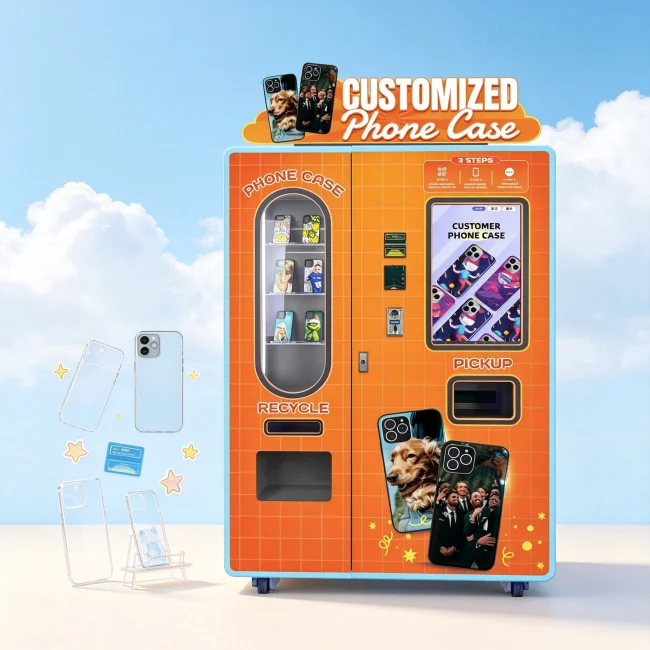
Let’s talk about what actually lands in your account.
A standard TPU+PC case costs you $1.50. Ink adds about $0.05 per print. So your all-in cost per case is roughly $1.55. Retail in the US runs $15-20 for a regular case, and magnetic MagSafe-compatible units sell for $30 and up.
That’s a 90%+ gross margin. On a good day at a busy mall, 30-50 cases walk out the door. Do the math — that’s a machine paying for itself in a matter of weeks, not years.
But — and this is the part nobody puts in their marketing — those numbers assume three things: foot traffic, a working print head, and a location where people actually want a custom case. Miss any one of them and the ROI timeline stretches. We’ve seen a beautifully installed machine in a low-traffic office building do eight sales a day. Still profitable, just not spectacular.
The machine doesn’t create demand. It captures it. That’s the honest truth.
What Actually Goes Wrong (and How to Avoid It)
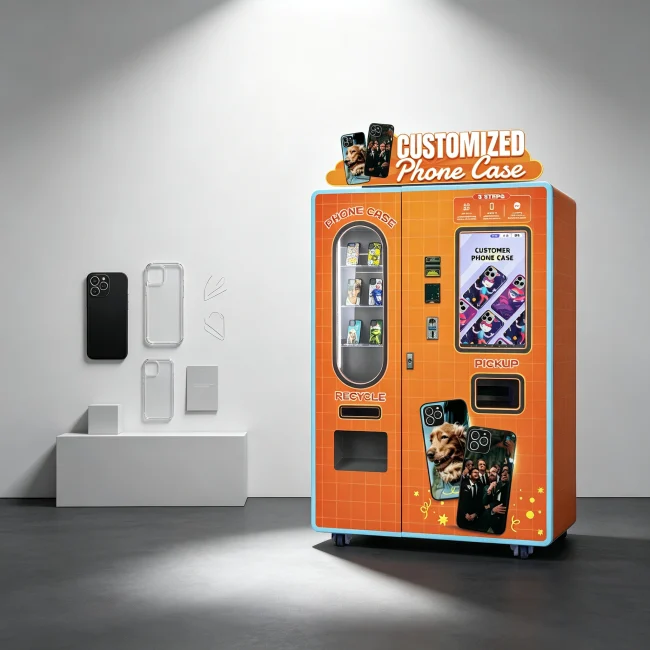
We support operators in 130+ countries, and the failure patterns are remarkably consistent.
Mistake one: skipping the UV print head calibration after shipping. Temperature and humidity shift during transit. A print head calibrated in our 22°C factory floor will behave differently in a Dubai mall or a Minnesota winter. The first thing you should do after install is run a test print and adjust. It takes twenty minutes and saves you a week of fuzzy output.
Mistake two: ignoring ink yield. The i1600 version uses 2000ml of ink that prints roughly 2,000-2,500 cases. If you’re doing 40 cases a day, that’s two months of ink. Operators who don’t track this run dry on a Saturday afternoon and lose a day of revenue. The cloud backend sends low-ink alerts — actually read them.
Mistake three: ordering the wrong case mix. Our cases cover about 90% of popular phone models globally. But if your venue skews toward a specific demographic — say, older Android users in a business district — your default mix will miss. Order a test batch, watch what sells for two weeks, then reorder based on real data.
Last month we helped an operator in Seoul recalibrate after he complained about color accuracy on dark cases. Turned out he’d been using the wrong ink profile for his ambient temperature. Small fix, big difference.
Factory Floor Reality: What You’re Actually Buying
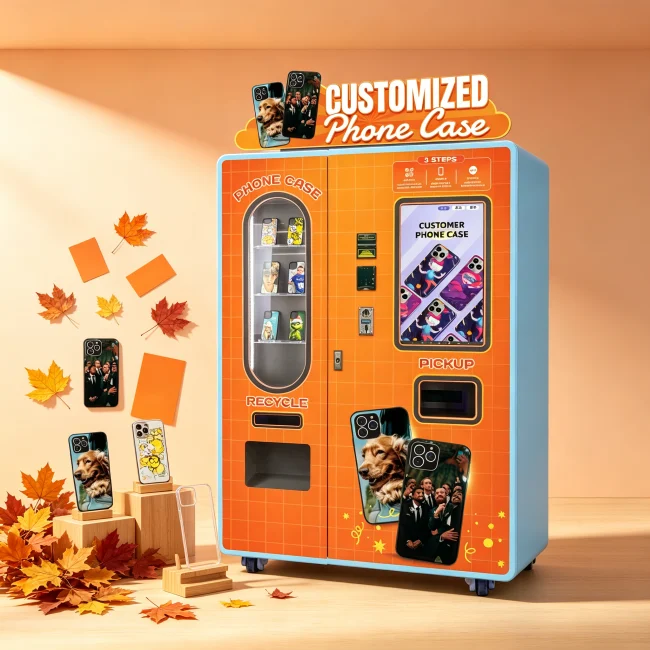
There’s a difference between a company that assembles vending machines and one that engineers them.
On our line, every WM880 goes through print head verification, dispensing mechanism testing, payment module calibration, and a 24-hour burn-in before it’s crated. The IoT backbone — 4G LTE + Wi-Fi, AWS cloud backend, OTA updates — is the same across every machine category we make, from phone cases to cotton candy to pizza.
That shared infrastructure matters more than people realize. It means one dashboard, one support team, one set of firmware updates across your entire fleet if you expand into other machine types later.
We’ve been building automation equipment since 2016. 20,000 square meters of production space, 200+ staff, 50+ pieces of production equipment, and certifications including CE, KC, PSE, and ISO 9001. That’s not a brag — it’s the baseline you should demand from any factory you’re about to wire money to.
If a supplier can’t show you their facility, their certifications, or their patent portfolio, walk away.
Choosing Between Machine Types (Because Phone Cases Aren’t Always the Answer)
We’d be doing you a disservice if we pretended phone cases were the right fit for every location. They’re not.
At a family entertainment center with lots of young kids, a balloon machine at $3,200 or a cotton candy unit at $4,999 might outperform a phone case machine simply because the impulse purchase happens faster and at a lower price point. At a gym, a protein shake machine makes more sense. At a university campus, phone cases and puzzles both work well — different customer psychology, both profitable.
Phone case machines shine in three specific environments: shopping malls (teen and young adult traffic), tourist areas (people want souvenirs that aren’t tacky), and transit hubs (bored travelers with time to kill).
If your location doesn’t match one of those, be honest with yourself before ordering.
Operators who diversify across two or three machine types consistently outperform single-machine operators. That’s not a sales line — it’s what the deployment data shows.
Customization Options Most Buyers Don’t Know About
The machine you order doesn’t have to look like the machine everyone else has.
We offer exterior customization including custom painting stickers and lightbox branding, plus full UI customization for operators who want their own branded interface on the 27-inch touchscreen. For larger fleet operators, we can deploy a dedicated server so your data lives on your own infrastructure rather than a shared cloud.
There’s also an SDK available for third-party integration if you want to connect the machine to your own app or loyalty system.
One operator in Australia built an entire brand around his three-machine fleet — custom lightbox, branded UI, and a QR code loyalty program. He’s now opening his fourth location. The customization cost was a fraction of what a marketing agency would charge for a single campaign.
If you want to explore what’s possible, our custom phone case vending machine guide walks through the OEM/ODM process step by step.
Payment, Connectivity, and the Boring Stuff That Matters
Every machine ships with selectable payment configuration: coin, banknote, credit card, and QR code. In practice, card and QR dominate in most Western markets. Coin still matters in parts of Asia and Latin America.
The Nayax card reader handles debit, credit, QR, and NFC mobile payments, and includes backend account inquiry and bill export. For operators running multiple machines, that reporting capability alone justifies the cost.
Network connectivity is 4G LTE plus Wi-Fi on all WM880 models. Power is 110V-220V, so it works in essentially every market without a transformer.
None of this is glamorous. But when a machine goes offline because the payment reader isn’t certified for your country’s banking system, glamour doesn’t help you. We’ve seen it happen to operators who bought from suppliers that didn’t bother with regional compliance.
Support: The Thing You’ll Only Appreciate When Something Breaks
Every machine comes with a 1-year standard warranty and lifetime technical support. Non-man-made damage parts ship by air at our cost. Tools and spare parts are in the crate. There are step-by-step guidance videos on YouTube, and a 24/7 engineer team working three shifts.
But the part most buyers underestimate is the onboarding. We help with installation training, deployment planning, operations training, and ROI calculation reports based on your specific venue. That last one is genuinely useful — it’s how you know whether you should order a second machine in month three or wait until month six.
Software updates are included. So is the AI-powered design generator, the QR code interaction system, and the AWS cloud backend that lets you monitor sales, inventory, and machine health from your phone.
What It Actually Costs (and Why the Number Isn’t the Whole Story)
The WM880 F1080 starts at US$5,299 per unit. The i1600u1 version is US$6,299. The i3200 upgrade version is US$6,979.
Those are single-unit reference prices, and they’re a fair starting point for planning. But pricing does shift throughout the year, and we frequently run seasonal promotions around trade show periods and year-end. It’s genuinely worth a conversation with our team before you assume the listed number is the final number — many operators end up with a better arrangement once we understand their venue, volume, and timeline.
For orders of multiple units, contact our team for a personalized quote with volume discounts.
Consumables matter too. Standard cases run $1.50 per unit, magnetic cases $2.50. Ink sets are $100 for the i1600 version and $160 for the F1080 version, each yielding roughly 1,500-2,000 prints. Those costs are baked into the margin math we walked through earlier.
Getting Started Without Getting Burned
If you’re serious about this, here’s the sequence that works:
- Validate your location first. Walk the site at different hours. Count foot traffic. Talk to the venue manager about placement and power access.
- Start with one machine. Even if you can afford three, prove the concept with one before scaling.
- Order a mixed case batch. Don’t commit to 500 of one model. Test the market for two weeks.
- Set up your cloud dashboard on day one. Watch the data. It’ll tell you things your gut won’t.
- Plan your second machine before you need it. Lead times exist. So does demand seasonality.
If you want a deeper walkthrough of the full business setup, our phone case vending machine business plan for 2026 covers the financial modeling in detail. And if you’re still deciding between DIY approaches and a full machine, this comparison of DIY vs. factory-built units is worth ten minutes of your time.
For a broader look at the category, the phone case vending machines overview page lays out the full lineup. And if you’re specifically evaluating print quality and speed before committing, the WM880 product page has the technical detail.
The Bottom Line
A high-profit phone case vending machine from a Chinese factory is a real opportunity — but only if you buy from a real factory, understand the unit economics, and place the machine somewhere people actually want custom cases.
The margin is there. The technology is there. The question is whether you’re willing to do the location homework before you spend the money.
If you’d like to talk through your specific situation — venue type, budget, target market — our team offers free consultation on model selection and placement strategy. We can also put together a personalized quote based on your setup, and if you’re ordering multiple units, we offer competitive bulk pricing.
Head over to nailvending.com to see the full range, or just drop your WhatsApp number below and one of our vending specialists will reach out directly. Share a few details about your venue and we’ll come back with pricing, specs, and honest placement advice — usually within a few hours. No pressure, no scripts. Just a straight conversation about whether this makes sense for you.
FAQ
How much does a phone case vending machine from a Chinese factory actually cost?
Single-unit reference prices start at US$5,299 for the WM880 F1080 version and go up to US$6,979 for the WM880+ with the i3200 print head. Those are standard prices — for multi-unit orders, reach out to our team for a personalized quote with volume discounts.
What’s the realistic profit margin per case?
Your cost is roughly $1.55 per case ($1.50 for the case plus about $0.05 for ink). Retail runs $15-20 for standard cases and $30+ for magnetic MagSafe-compatible ones in the US market. That’s a gross margin above 90%.
How long until I make my money back?
Under normal traffic conditions, many operators see payback in a few weeks. That assumes 30-50 cases per day at a decent location. Lower-traffic venues take longer — sometimes two to three months.
How many cases can the machine hold before refilling?
The WM880 models hold 1,020-1,025 cases per refill. At 40 sales a day, that’s roughly 25 days of operation before you need to restock.
How long does it take to print one custom case?
Between 1 and 3 minutes per case, depending on the design complexity and print head version. The i3200 model is the fastest.
Do I need technical skills to operate this?
Not really. The machine handles the printing, dispensing, and inventory monitoring automatically. You need to refill cases and ink, respond to low-stock alerts, and do basic cleaning. We provide video training and remote online guidance for everything else.
What certifications should I look for when buying from a Chinese factory?
At minimum, CE for Europe, KC for Korea, and PSE for Japan, plus ISO 9001 for manufacturing quality. Wider Matrix holds all of these, along with 5+ self-developed patents.
Can I customize the machine’s appearance and interface?
Yes. We offer custom painting stickers, lightbox branding, and full UI customization. For larger fleet operators, we can also deploy a dedicated server for your data. Contact us for a custom quote based on your design complexity.
What’s the warranty and support situation?
Every machine includes a 1-year standard warranty and lifetime technical support. Non-man-made damage parts ship by air at our cost. There’s a 24/7 engineer team working three shifts, plus video technical support and remote online guidance.
Can I visit the factory before ordering?
Most of our clients don’t make the trip, but we welcome factory visits and can arrange video walkthroughs of the production line if you’d rather see it remotely. Our facility is 20,000 square meters with 200+ staff.