¿Pueden los clientes subir fotos para imprimir uñas? Sí, así es como funciona
Sí, los clientes pueden subir sus propias fotos para imprimirlas en las uñas en máquinas expendedoras modernas de uñas postizas como la Wider Matrix WM860. La máquina permite subir imágenes de forma inalámbrica a través de una aplicación dedicada o del navegador de la pantalla, lo que permite a los clientes seleccionar una foto de la galería de su celular, aplicarla a un juego de uñas postizas y recibir el producto terminado en unos 5 minutos. Esta característica transforma una experiencia estándar de compra en una máquina expendedora en un evento de venta al por menor personalizado, y es un gran impulsor tanto de las ventas como del revuelo en las redes sociales.
Entra a cualquier centro comercial concurrido o lugar turístico y verás a la gente haciendo fila para comprar productos personalizados. Las máquinas expendedoras de diseños para uñas aprovechan ese mismo impulso. La WM860 imprime con una resolución de 600 DPI utilizando tinta UV de calidad industrial, por lo que las fotos subidas se ven nítidas y vibrantes en cada juego de uñas. No necesitas un técnico de uñas ni una cita: solo elige un diseño (o tu propia imagen), paga y llévate un juego de uñas postizas personalizadas listas para aplicar en casa.
💡 Oper ador Insight : Coloca la máquina cerca de un lugar muy frecuentado en las redes sociales, como un muro de fotos o la entrada. Los clientes que suben selfies o fotos de sus mascotas suelen compartir el proceso en línea, lo que te brinda publicidad gratuita.
Cómo funciona la subida de fotos en las máquinas expendedoras de productos para uñas
El proceso es más sencillo de lo que podrías pensar. Este es el flujo típico en una máquina como la WM860:
- La pantalla táctil HD de 27 pulgadas muestra una galería de diseños integrados (más de 10 000 opciones), además de un botón que dice “Sube tu foto”.
- Los clientes se conectan mediante un código QR, Bluetooth o Wi-Fi: escanean un código con su celular, abren el enlace y eligen una imagen de su galería o de sus redes sociales.
- La inteligencia artificial de la máquina coloca automáticamente la imagen en el juego de uñas postizas, ajustando el tamaño y la alineación; no es necesario recortarla manualmente.
- Una vez realizado el pago, la impresora de doble LED UV seca la tinta en unos 30 segundos, y el juego terminado cae en el contenedor de recolección.
Desde una perspectiva comercial, esta característica es una mina de oro. El precio promedio de venta al público de un juego de uñas postizas personalizadas es de $14.99, mientras que el costo total de los materiales (juego de uñas + tinta + kit de herramientas) ronda los $1.20; eso representa un margen de 87%. Y como cada juego es único, los clientes perciben un mayor valor y están dispuestos a pagar un precio más alto.
🎯 Tip de colocación: Coloca la máquina cerca de tiendas de productos de belleza o salones de manicura. No estás compitiendo con ellos, sino que ofreces una alternativa rápida y sin compromiso que complementa sus servicios.
Por qué subir fotos genera más ventas
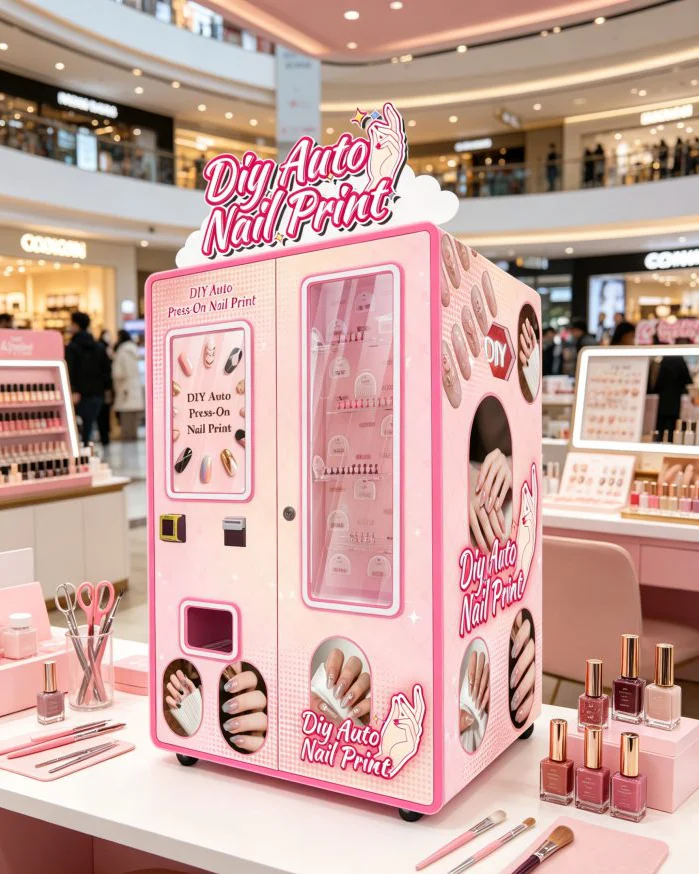
Seamos honestos: la mayoría de las máquinas expendedoras venden lo mismo a todos. Dulces, botanas, bebidas. Son prácticas, pero aburridas. Una máquina expendedora de diseños para uñas le da un giro a ese modelo. Cada transacción es única porque el cliente la diseña él mismo.
He visto a operadores reportar entre 35 y 50 pedidos al día en lugares con mucho tráfico, como aeropuertos y atracciones turísticas. A 50 pedidos diarios, eso equivale a $19,500 de ganancia mensual. ¿El plazo de recuperación de la inversión? Tan rápido como 12 días en épocas de mayor volumen. Incluso con una estimación conservadora de 20 pedidos al día, se obtienen alrededor de $7,800 de ganancia mensual y un plazo de recuperación de 31 días.
¿Por qué la gente sube sus propias fotos? Es algo personal. Una foto de su perro, de sus hijos, un recuerdo de vacaciones… eso convierte un accesorio desechable en un recuerdo. Y el factor de compartir en redes sociales es real: a la gente le encanta presumir de artículos personalizados, etiquetar la ubicación y contarles a sus amigos dónde los compraron.
Formatos de imagen compatibles y consejos sobre calidad
La WM860 admite formatos de imagen comunes como JPEG y PNG. Para obtener los mejores resultados, las fotos deben tener al menos 800×800 píxeles; aunque la IA de la máquina mejora la calidad de las imágenes de menor resolución, partir de una foto nítida garantiza una impresión más definida. Las selfies, los retratos de mascotas y los gráficos sencillos quedan muy bien. Los patrones muy detallados o las imágenes con mucho texto tal vez requieran una revisión rápida en la pantalla de vista previa, que la máquina muestra antes de realizar el pago.
Hay algo que debes tener en cuenta: la máquina imprime en juegos de uñas postizas, no directamente en los dedos. Así que la foto aparece en un juego de 10 uñas postizas que la clienta se aplica después con el pegamento que viene incluido. En realidad, eso es una ventaja: pueden llevarse el juego a casa, aplicárselo cuando les dé la gana e incluso cambiar de diseño todos los días.
⚠️ Error común: Algunos operadores dan por sentado que cualquier imagen se imprimirá a la perfección. Anima a los clientes a usar fotos con alto contraste y bien iluminadas. Las imágenes oscuras o borrosas pueden perder detalles en la impresión. Un pequeño letrero cerca de la máquina con un código QR que diga “Consejos para obtener los mejores resultados” puede reducir las solicitudes de reembolso.
Subida de fotos vs. biblioteca de diseños integrada
La WM860 cuenta con una enorme biblioteca de diseños: más de 10 000 patrones, ilustraciones y fuentes artísticas. Así, los clientes no se ven obligados a subir una foto si prefieren un diseño ya listo. Pero la opción de subir archivos es lo que distingue a esta máquina de las máquinas expendedoras estándar. Convierte un producto básico en un producto personalizado.
Desde el punto de vista de las ventas, recomendaría fijar un precio ligeramente más alto para las subidas personalizadas que para los diseños integrados. Por ejemplo, $14.99 por un conjunto de fotos personalizado frente a $12.99 por un diseño predefinido. Esto crea un nivel de valor percibido y fomenta más compras de productos premium. Algunos operadores también lanzan promociones como “Sube la foto de tu mascota para el Día Nacional de las Mascotas” para impulsar picos de ventas estacionales.
Requisitos técnicos para subir fotos
Para que la máquina acepte cargas inalámbricas, necesitas una conexión a Internet estable. El WM860 utiliza la infraestructura en la nube de AWS para un procesamiento rápido de imágenes. Se recomienda una conexión 4G LTE o Wi-Fi con una velocidad de descarga de al menos 10 Mbps. El sistema de autorreparación de la máquina se reinicia y realiza diagnósticos automáticamente si surge algún problema de conectividad.
| Característica | Especificaciones |
|---|---|
| Método de carga | Código QR / aplicación / navegador en pantalla |
| Formatos de imagen | JPEG, PNG |
| Resolución mínima | Se recomienda una resolución de 800 × 800 píxeles |
| Resolución de impresión | 600 DPI |
| Posicionamiento automático mediante IA | Sí |
| Tiempo de impresión por juego | ~30 segundos (incluido el curado UV) |
¿Es la subida de fotos una buena opción para tu negocio?
Si tu objetivo es un lugar con mucho tráfico peatonal y un público que valora la personalización —como centros comerciales, campus universitarios o atracciones turísticas—, entonces sí, una máquina expendedora de esmaltes de uñas con función de carga de fotos es una excelente adición. La máquina requiere aproximadamente 120 × 102 cm de espacio en el piso y funciona con una conexión eléctrica estándar de 110 V/220 V. La inversión inicial para una WM860 es de $5,800, más el envío y los consumibles iniciales, lo que suma un total de aproximadamente entre $8,670 y $10,900, dependiendo de tu región.
Pero no es para todos. Es posible que en zonas con poco tráfico o en lugares donde los clientes tienen prisa (como las estaciones de metro) no se generen suficientes compras impulsivas. Además, la máquina requiere un reabastecimiento regular de juegos de uñas (capacidad de 720 por recarga) y el reemplazo ocasional del cabezal de impresión (cada 1 a 2 años, lo cual no está cubierto por la garantía).
🛠️ Nota del Comprador: Los cabezales de impresión son consumibles con una vida útil de 1 a 2 años. Calcula un presupuesto de alrededor de $200-400 para su reemplazo. La máquina incluye un sistema de autodiagnóstico que te avisa cuando se están acabando la tinta o los juegos de clavos, para que nunca te tome por sorpresa.
Para los operadores que quieran saber más sobre esta categoría en general, consulten ¿Existe una máquina para imprimir diseños en las uñas? Tu guía para 2026. Si estás listo para sumergirte en los números, el Máquina expendedora de estampados para uñas: la guía definitiva de costos y ganancias para 2026 desglosa cada gasto y cada fuente de ingresos.
Preguntas frecuentes
¿Los clientes pueden subir cualquier foto o hay restricciones?
Los clientes pueden subir cualquier imagen en formato JPEG o PNG desde su celular. La inteligencia artificial de la máquina recorta y coloca automáticamente la imagen en el juego de uñas postizas. El contenido inapropiado no se filtra automáticamente, por lo que algunos operadores optan por supervisar el proceso mediante una cámara remota o colocar un letrero con las normas de uso.
¿Cuánto tiempo pasa desde que se sube el archivo hasta que se obtiene el producto terminado?
Todo el proceso —desde elegir una foto hasta recibir el conjunto impreso— dura unos 5 minutos. El ciclo de impresión y curado UV en sí dura 30 segundos. La mayor parte del tiempo se dedica a buscar y subir fotos.
¿Cuál es el margen de ganancia de los juegos de uñas con fotos personalizadas?
Cada conjunto personalizado cuesta aproximadamente $1.00-$1.20 para producir (conjunto de uñas + tinta + kit de herramientas). A un precio al por menor de $14.99, eso es un margen de 87%. Con 20 - 35 ventas por día, el beneficio mensual oscila entre $7.800 y $13.650.
¿La máquina imprime directamente en los dedos o en las uñas de presión?
El WM860 imprime solo en conjuntos de uñas a presión. Los clientes nunca introducen sus dedos en la máquina. Reciben un conjunto de uñas impresas a medida con pegamento, que aplican en casa. Esto es más seguro y más higiénico que la impresión digital directa.
¿Qué tipo de mantenimiento necesita la máquina?
El mantenimiento básico incluye rellenar los conjuntos de uñas, reemplazar los cartuchos de tinta (cada ~ 5.000 impresiones) y la limpieza ocasional del cabezal de impresión. La máquina ejecuta autodiagnóstico y envía alertas a través de la plataforma IoT. Los cabezas de impresión deben ser reemplazados cada 1 - 2 años.
¿Necesito una conexión especial a internet para subir fotos?
Se recomienda una conexión estable a Internet con una velocidad de descarga de al menos 10 Mbps. La máquina admite 4G LTE y Wi-Fi. Sin internet, la función de carga de fotos no funcionará, pero la biblioteca de diseño integrada seguirá disponible.
¿Puedo vender pestañas falsas u otros productos de la misma máquina?
Sí, el WM860 tiene compartimentos adicionales que pueden vender pestañas falsas y otros pequeños artículos de belleza. Esto le permite aumentar la venta de accesorios junto con los conjuntos de uñas personalizados, aumentando el valor promedio de la operación.
¿Cómo se compara la WM860 con las impresoras de uñas directas a dedos?
Las impresoras direct-to - finger (como Nailbot) imprimen en uñas naturales, pero requieren que el cliente se mantenga quieto e inserte los dedos. La WM860 es una máquina expendedora que imprime en juegos de prensa: es más rápida, más higiénica y no necesita un técnico. Para el comercio minorista desatendido, el modelo de máquina expendedora es mucho más escalable.
“La belleza de la venta de uñas con foto es que combina dos tendencias poderosas en el comercio minorista: la personalización y la automatización. Los clientes no solo compran un producto, sino que crean una memoria. Para los operadores, la economía de la unidad es convincente: alto margen, baja mano de obra y un producto que prácticamente se comercializa a través del intercambio social. La clave es la ubicación, póngalo donde la gente tenga tanto tiempo como ingresos disponibles, y verás ingresos diarios consistentes ”.”